
AI Hub Planned for Clark Atlanta University with $2.79M NSF Grant.
Clark Atlanta University (CAU), in collaboration with Georgia Tech’s NSF Artificial Intelligence (AI) Research Institute for Advances in Optimization (AI4OPT), has been awarded a four-year $2.79 million grant (Award ID 2402493) by the National Science Foundation (NSF) to create an AI Hub. This collaborative effort aims to advance AI education and research at minority-serving institutions, particularly historically Black colleges and universities (HBCUs).
This initiative, part of the NSF ExpandAI program, aims to boost minority-serving institution participation in AI research, education, and workforce development through capacity-building projects and partnerships within the NSF-led National AI Research Institutes ecosystem.
Building an AI community is no easy feat, but the CAU-GT/AI4OPT collaboration is prepared to meet it. The project, known as AIHUB@CAU, will be led by principal investigator Charles B. Pierre, associate professor in CAU’s Department of Mathematical Sciences.
"The mission of the grant aligns with the AI4OPT Faculty Training Program, which focuses on strategies to increase minority participation in AI research programs from HBCUs to other minority-serving institutions," said Pierre, who also leads the Educational and Diversity Initiatives at AI4OPT. "Our goal is to ensure diverse representation in the AI field."
The collaboration will use existing educational resources and infrastructure to build centers of excellence in AI and a community of empowered Black AI researchers.
"We anticipate challenges in developing coursework, including finding qualified industry professionals to teach and preparing academic professors unfamiliar with AI," Pierre said. "Our aim is to establish Ph.D. programs at CAU and position the university as a hub for AI training, addressing these issues head-on."
AIHUB@CAU will integrate industry partnerships to accelerate curriculum development and real-world applications. It expands AI education beyond machine learning to encompass decision-making and applications in fields like business analytics, cyber-physical security, and operations research.
Partially funded through NSF's Louis Stokes Alliances for Minority Participation program, this award underscores NSF's commitment to diversity in STEM fields through impactful educational and research initiatives.
"Establishing programs at institutions like Clark Atlanta University and AI4OPT at Georgia Tech provides students with essential resources and tools to succeed in this ever-evolving field," Pierre noted.
Goals and Structure of the AI Education Program
Main Goals of Creating AI Courses at the Undergraduate and Graduate Levels:
- Close the gap of AI graduates from HBCUs at undergraduate and graduate levels.
- Prepare HBCU students for the AI workforce.
- Align with the vision of AI4OPT at Georgia Tech to "democratize access to AI education."
Impact on Students' Career Prospects and the AI Research Community:
- Undergraduate courses and programs will prepare students for entry-level positions in the field.
- Graduate courses and programs will prepare students for research and participation in the AI research community.
Role and Contribution:
- AI4OPT at Georgia Tech will assist CAU with the development of both undergraduate and graduate courses and programs.
- Offer research opportunities to CAU students at the undergraduate and graduate levels.
- AI4OPT at Georgia Tech will be a partner in the established AI Research Hub.
Support for Development of MS and Ph.D. Courses:
- Use current courses at Georgia Tech as a template.
- Use the courses offered through the Faculty Training Program (FTP) of AI4OPT.
Foundational AI Courses:
- Courses already taught by CAU faculty in the AI4OPT FTP.
- Courses available at Georgia Tech.
- New courses to be developed by AIHUB@CAU based on Intel material, focusing on computer vision and natural language processing.
- Courses in applied optimization developed by AI4OPT.
- New use-inspired AI courses teaching applications of AI in various domains, such as supply chains, security, chemistry, and manufacturing.
Research Opportunities:
- The Undergraduate Research Program (URP) will provide students with early exposure to AI research, including summer internships at Georgia Tech and other AI4OPT sites.
- The graduate programs will include an 18-month non-thesis master's degree with a summer internship and capstone project, and a two-year thesis master's degree supported by a six-month research project.
Structure of the New Master in AI Program:
- Courses in five categories to support the master’s program:
- Existing courses at CAU taught in the AI4OPT FTP.
- Courses available at Georgia Tech.
- New courses based on Intel material.
- Applied optimization courses developed by AI4OPT.
- New courses developed by AIHUB@CAU focusing on AI applications in various domains.
Collaborations and Internships:
- Joint supervision of research projects by CAU and AI4OPT faculty.
- Summer internships starting in 2026.
- Capstone projects facilitated by Georgia Tech and industrial partners.
About AI4OPT
The Artificial Intelligence (AI) Research Institute for Advances in Optimization, or AI4OPT, aims to deliver a paradigm shift in automated decision-making at massive scales by fusing AI and Mathematical Optimization (MO) to achieve breakthroughs that neither field can achieve independently. The Institute is driven by societal challenges in energy, logistics and supply chains, resilience and sustainability, and circuit design and control. To address the widening gap in job opportunities, the Institute delivers an innovative longitudinal education and workforce development program.
About Georgia Tech
The Georgia Institute of Technology, or Georgia Tech, is a top 10 public research university developing leaders who advance technology and improve the human condition. The Institute offers business, computing, design, engineering, liberal arts, and sciences degrees. Its nearly 40,000 students, representing 50 states and 149 countries, study at the main campus in Atlanta, at international campuses, and through distance and online learning. As a leading technological university, Georgia Tech is an engine of economic development for Georgia, the Southeast, and the nation, conducting more than $1 billion in research annually for government, industry, and society.
About Clark Atlanta University
Clark Atlanta University was formed with the consolidation of Atlanta University and Clark College, both of which hold unique places in the annals of African American history. Atlanta University, established in 1865 by the American Missionary Association, was the nation’s first institution to award graduate degrees to African Americans. CAU is also the largest of the 37-member UNCF institutions. CAU, established four years later in 1869, was the nation’s first four-year liberal arts college to serve a primarily African American student population. Today, with over 4,000 students, CAU is the largest of the four institutions (CAU, Morehouse College, Spelman College, and Morehouse School of Medicine) that comprise the Atlanta University Center Consortium.
About National Science Foundation
The U.S. National Science Foundation propels the nation forward by advancing fundamental research in all fields of science and engineering. NSF supports research and people by providing facilities, instruments and funding to support their ingenuity and sustain the U.S. as a global leader in research and innovation. With a fiscal year 2023 budget of $9.5 billion, NSF funds reach all 50 states through grants to nearly 2,000 colleges, universities and institutions. Each year, NSF receives more than 40,000 competitive proposals and makes about 11,000 new awards. Those awards include support for cooperative research with industry, Arctic and Antarctic research and operations, and U.S. participation in international scientific efforts.
News Contact
Breon Martin
AI Research Communications Manager
Georgia Tech
When Alexandria Sweeny, better known as Alex, considered what she wanted to accomplish before graduating from Drew Charter School, the then high school junior set two goals: complete her engineering internship and make a positive impact.
She did both while strengthening her coding knowledge during her time as a camper and mentor at the Seth Bonder Camp in Computational and Data Science for Engineering (SBC).
“I did it when it was fully virtual, and it was definitely an experience,” said Sweeny who spent a week being introduced to computing and data science where she performed virtual activities, last June.
The camp, which is offered either as an online course or on-campus summer camp at Georgia Tech, is designed to build students’ problem-solving and analytical skills while furthering their interest in computer science as a potential career. It is also part of AI4OPT’s mission to inspire young Georgians to pursue STEM (science, technology, engineering and mathematics).
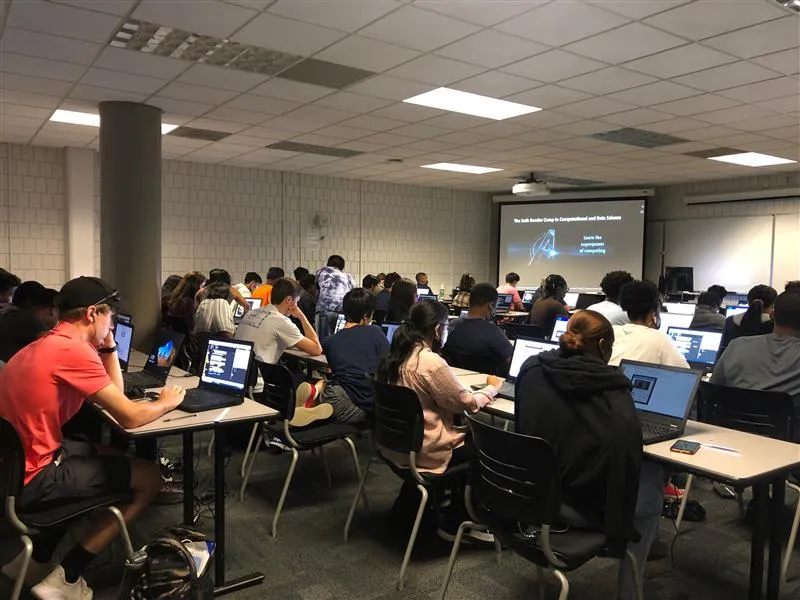
AI4OPT hosted its first in-person summer camp at Georgia Tech in June. The camp brought together 60 students from schools across Georgia including Drew Charter, Banneker High School, and Westlake High School.
Sweeny was asked to return to this particular camp—but this time, as a mentor.
“Of course, I said yes, because it was something fun that I could do over the summer preparing for college without it being too hefty,” said Sweeny. “It was something that I felt prepared for from attending the camp.”
Responses like Sweeny’s motivates SBC Site Managers like Reem Khir to introduce more bright minds to the camp centered around computer programming logic, programming language for AI, and teamwork.
“We expose them [high school students] to certain types of education areas like Twitter analysis, how to solve a sudoku, and even computational biology, if they wanted to consider a career in biology,” said Khir, who joined the camp last year to help students with assignments. This year, she took on even bigger leadership role by maintaining and observing two camps and facilitating 50 students and seven teaching assistants (TAs). She worked under a ‘student to student and student to TA’ interactive structure so that each participant took away a useful skill in data science.
“It’s the time where high school students start forming opinions and decisions about the career path they want to pursue,” said Khir. “The steppingstone is their college education, and we can help students in that period.”
AI4OPT Will Acquire and Advance Seth Bonder Camp
AI4OPT is working to adopt a short-term system used to track students after the camp. The institute wants to build up the system to see majors, colleges, and career paths each student has vowed to pursue before they head off to college or the workforce.
“This is a critical period for students,” said Khir. “It’s a time where students start thinking about a major for college and later impacting the next 20 or 30 years of their life. Being a part of that is very unique in terms of creating a positive influence in the next generation.”
AI4OPT is taking the lead over the SBC to offer the initiative more organizational support as the program has seen tremendous growth and has become a much broader initiative. The Seth Bonder Foundation, which first introduced the camp to those ages 10-18, will continue to fund the camp now more targeted towards high school students interested in engineering, but do not have access to computer science and/or data science in their middle and high schools.
“A lot of the different communities are not exposed to this and may never see this opportunity. The Seth Bonder Camp exposes high school students to AI opportunities and gives them skills to successfully enter the field of STEM with confidence,” said Professor Pascal Van Hentenryck, who’s brought his data sciences skills and knowledge to Georgia Tech and leads both AI4OPT and the SBC.
AI4OPT is in transition to lead the SBC to offer more organizational support as the program sees tremendous growth. The research Institute will expand the longitudinal camps to engage middle and high school students in these topics, while also bringing AI education and research programs to HBCU’s and Hispanic-serving colleges throughout the nation, addressing the widening gap in job opportunities.
Though Sweeny has transitioned away from coding and transcended into research, she never stopped setting goals even now as a first-year biomedical engineering major at Georgia Tech.
“Do anything you can to take it [the SBC] even if you don't want to go into coding,” said Sweeny. “It is a good way to meet new people learn new skills, it is something that you don't necessarily have to have a love for coding to have to do it.”
To learn more about the Seth Bonder Camp in Computational and Data Science for Engineering and to partner with the camp, visit sethbondercamp.isye.gatech.edu.
(Writer’s note: This article is part of a series highlighting AI4OPT members, students, education programs and professional development testimonies.)