
Jul. 10, 2025
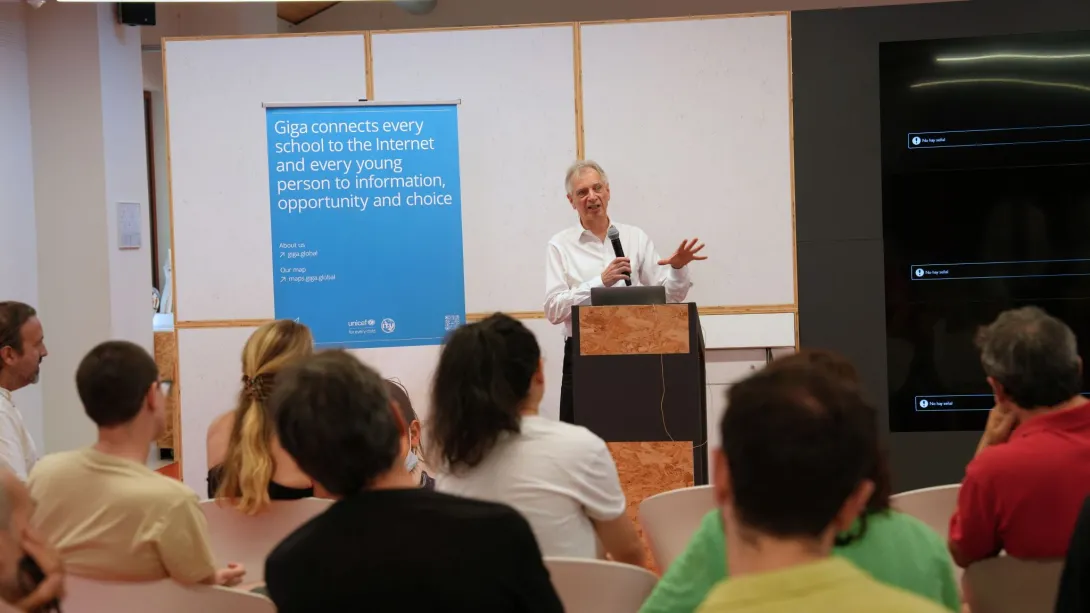
Giga, a global initiative focused on expanding internet connectivity to schools, launched its new tech and innovation event series “Giga Talks” on June 19 with a keynote address from Pascal Van Hentenryck, a leading artificial intelligence expert from the Georgia Institute of Technology.
Van Hentenryck serves as the A. Russell Chandler III Chair and Professor in Georgia Tech’s H. Milton Stewart School of Industrial and Systems Engineering. He is also the director of Tech AI, Georgia Tech’s new strategic hub for artificial intelligence, and the U.S. National Science Foundation AI Institute for Advances in Optimization (AI4OPT), which operates under Tech AI’s umbrella.
In his talk, “AI for Social Good,” Van Hentenryck showcased how AI technologies can drive impact across key sectors—including mobility, education, healthcare, disaster response, and e-commerce. Drawing from ongoing research and real-world deployments, he emphasized the critical role of human-centered design and interdisciplinary collaboration in developing AI that benefits society at large.
“AI has tremendous potential to serve the public good when guided by ethics, equity, and purpose-driven innovation,” said Van Hentenryck. “At Georgia Tech, our work aims to harness this potential to create meaningful change in people’s lives.”
The event marked the debut of Giga Talks, a new speaker series designed to convene global thought leaders, engineers, and policymakers around timely issues in technology and innovation. The initiative supports Giga’s broader mission to connect every school in the world to the internet and unlock digital opportunities for children everywhere.
A video recording of Van Hentenryck’s talk is available on here.
News Contact
Breon Martin
AI Marketing Communications Manager
Jul. 10, 2025
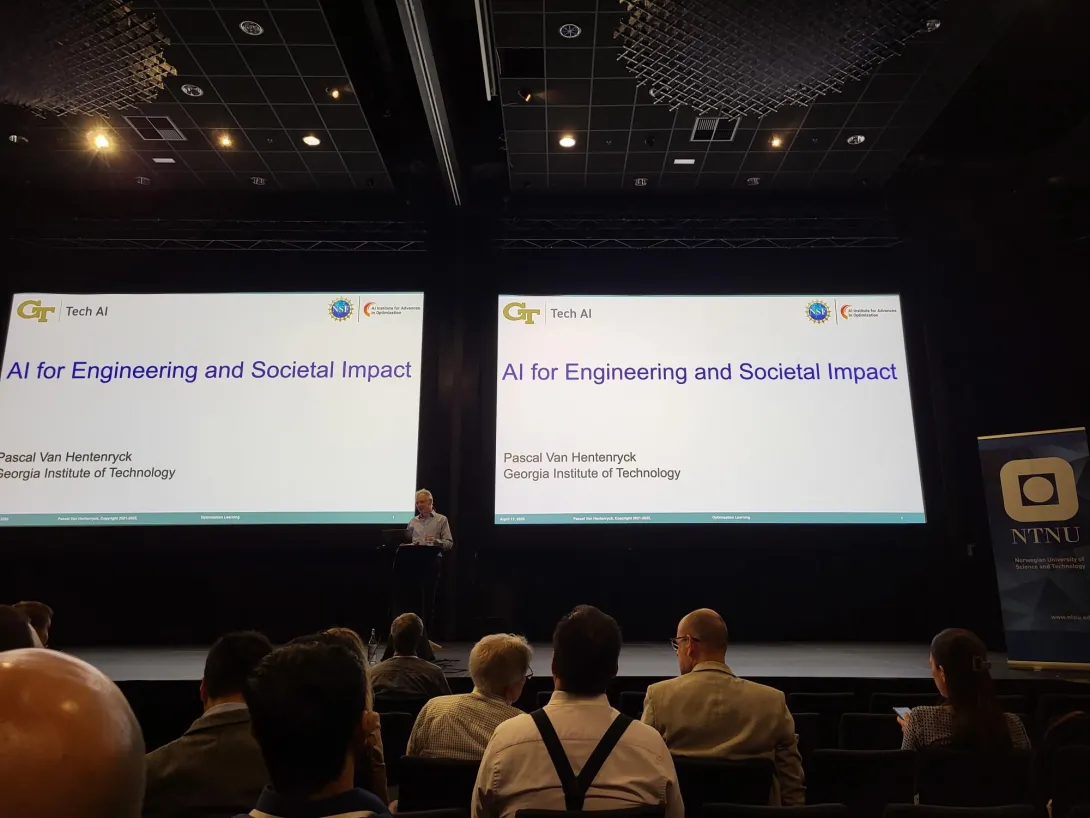
Pascal Van Hentenryck, the A. Russell Chandler III Chair and professor at Georgia Tech, and director of the U.S. National Science Foundation AI Institute for Advances in Optimization (AI4OPT) and Tech AI, delivered a keynote address at the 11th IFAC Conference on Manufacturing Modelling, Management and Control (MIM 2025), hosted by the Norwegian University of Science and Technology (NTNU).
Combining Technologies for Real-World Results
Van Hentenryck introduced a series of foundational approaches—such as primal and dual optimization proxies, predict-then-optimize strategies, self-supervised learning, and deep multi-stage policies—that enable AI systems to operate effectively and responsibly in high-stakes, real-time environments. These frameworks demonstrate the power of integrating AI with domain-specific reasoning to achieve results unattainable by either field alone.
“This is not just about building smarter algorithms,” Van Hentenryck said. “It’s about designing AI that can adapt, learn, and optimize under uncertainty—across supply chains, energy systems, and manufacturing networks.”
Grounded in Real-World Impact
The keynote aligned directly with the MIM 2025 focus on logistics and production systems. Drawing from recent work in supply chain optimization and smart manufacturing, Van Hentenryck emphasized how AI4OPT’s research is already generating measurable impact in industry.
MIM 2025, organized by NTNU’s Production Management Research Group and supported by MHI and CICMHE, featured more than 40 experts delivering keynotes, presenting research, and leading breakout sessions across topics in modeling, control, and decision-making in manufacturing and logistics.
About Tech AI
Tech AI is Georgia Tech’s strategic initiative to lead in the development and application of artificial intelligence across disciplines and industries. Serving as a unifying platform for AI research, education, and collaboration, Tech AI connects researchers, industry, and government partners to drive responsible innovation in areas such as healthcare, mobility, energy, sustainability, and education. Director of Tech AI, Pascal Van Hentenryck helps guide the institute’s research vision and strategic alignment across Georgia Tech’s AI portfolio. Learn more at ai.gatech.edu.
About AI4OPT
The AI Institute for Advances in Optimization (AI4OPT) is one of the National Science Foundation’s flagship AI Institutes and is led by Georgia Tech. The institute brings together experts in artificial intelligence, optimization, and control to tackle grand challenges in supply chains, transportation, and energy systems.
AI4OPT is one of several NSF-funded AI institutes housed within Tech AI’s collaborative framework, enabling cross-disciplinary research with real-world outcomes. Learn more at ai4opt.org.
News Contact
Breon Martin
AI Marketing Communications Manager
Jul. 10, 2025

Researchers at Georgia Tech have developed a new artificial intelligence tool that dramatically improves how companies plan their supply chains, cutting down the time and cost it takes to generate complex production and inventory schedules.
The tool, known as PROPEL, combines machine learning with optimization techniques to help manufacturers make better decisions in less time. It was created by researchers at the NSF AI Institute for Advances in Optimization, or AI4OPT, based at Georgia Tech under Tech AI (the AI Hub at Georgia Tech).
The technology is already being tested on real-world supply chain data provided by Kinaxis, a Canada-based company that supplies planning software to global manufacturers in industries ranging from automotive to consumer goods.
Vahid Eghbal Akhlaghi, senior research scientist at Kinaxis and former postdoctoral fellow at AI4OPT and the H. Milton Stewart School of Industrial and Systems Engineering (ISyE) at Georgia Tech, said, “Our industry partner has been instrumental in shaping PROPEL’s capabilities. By validating the approach with real operational data, we ensured it addresses true bottlenecks in supply chain planning.”
"PROPEL represents a leap forward in how we tackle massive, complex planning problems," said Pascal Van Hentenryck, lead researcher, the director of Tech AI and the NSF AI4OPT Institute, and the A. Russell Chandler III Chair and Professor at Georgia Tech with appointments in the colleges of engineering and computing. "By combining supervised and reinforcement learning, we can make near-optimal industrial-scale decisions, an order of magnitude faster."
Traditional supply chain planning problems are typically solved using mathematical models that require immense computing power—often too much to meet real-time business needs. PROPEL, short for Predict-Relax-Optimize using LEarning, reduces this burden by teaching the AI model to first eliminate irrelevant decisions and then fine-tune the solution to meet quality standards.
Reza Zandehshahvar, one of the paper’s co-authors and postdoctoral fellow with the NSF AI4OPT and the H. Milton Stewart School of Industrial and Systems Engineering (ISyE) at Georgia Tech, said the breakthrough lies not just in the AI algorithms but in how they're trained and deployed at scale.
“Many AI models struggle when applied to problems with millions of variables. PROPEL was built from the ground up to handle industrial complexity, not just academic examples,” Zandehshahvar said. “We’re seeing real improvements in both solution speed and quality.”
In trials using Kinaxis’ historical industrial data, PROPEL achieved an 88% reduction in the time needed to find a high-quality plan and improved solution accuracy by more than 60% compared to conventional methods.
While many AI methods in supply chain rely on simulated data or simplified models, PROPEL’s performance has been validated using real-world scenarios, ensuring its reliability in high-stakes operational settings.
The Georgia Tech team says PROPEL could benefit industries that manage large, multi-tiered production networks, including pharmaceuticals, electronics, and heavy manufacturing. The researchers are now exploring partnerships with additional companies to deploy PROPEL in live environments.
Access the abstract on arXiv.
News Contact
Breon Martin
AI Marketing Communications Manager